When an enterprise requires an HSM, your application code can use private keys but can never hold them. A Hardware Security Module is a physical device that protects keys. The Java Cryptography Architecture is a standard framework for cryptography. In standard Java applications, developers load private keys from software keystore files into heap memory. Once key bytes enter application memory, a memory dump or an unpatched vulnerability can expose the secret material. A Thales Luna HSM prevents this vulnerability because private keys remain inside dedicated hardware boundaries. Your application receives only an opaque handle to each key. The private key never leaves the appliance. Because the key never enters application memory, your code cannot leak key bytes. Every private key operation becomes an explicit call to the external hardware module.
Application Partitions and Key Boundaries
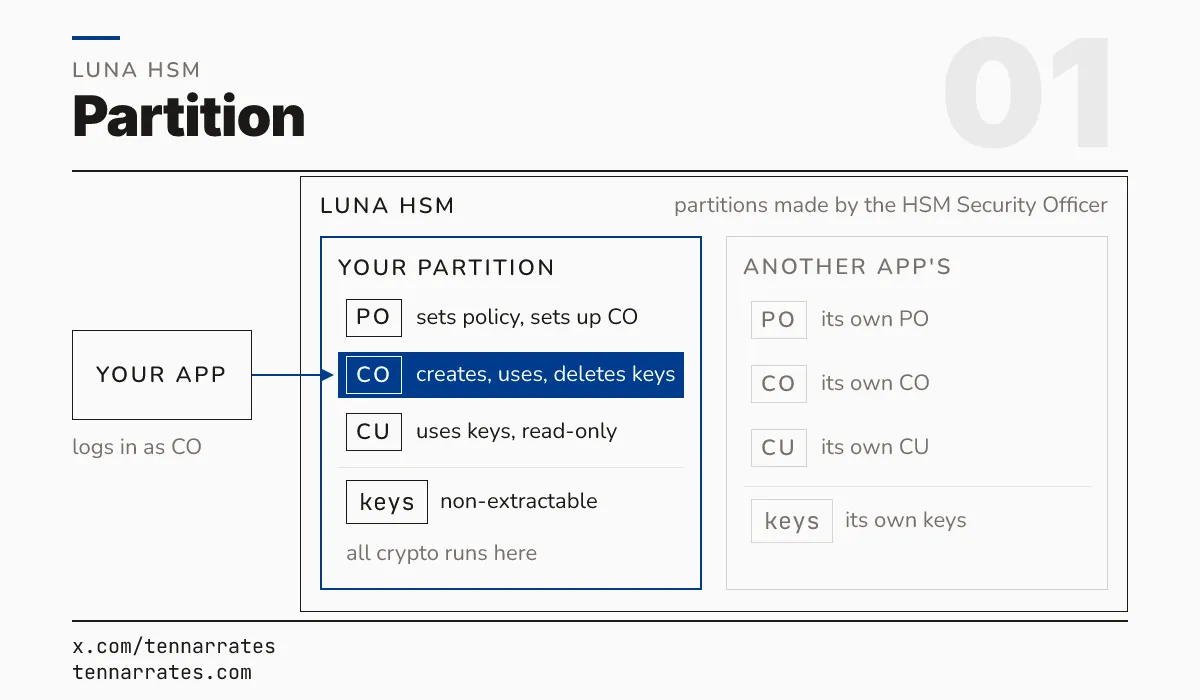
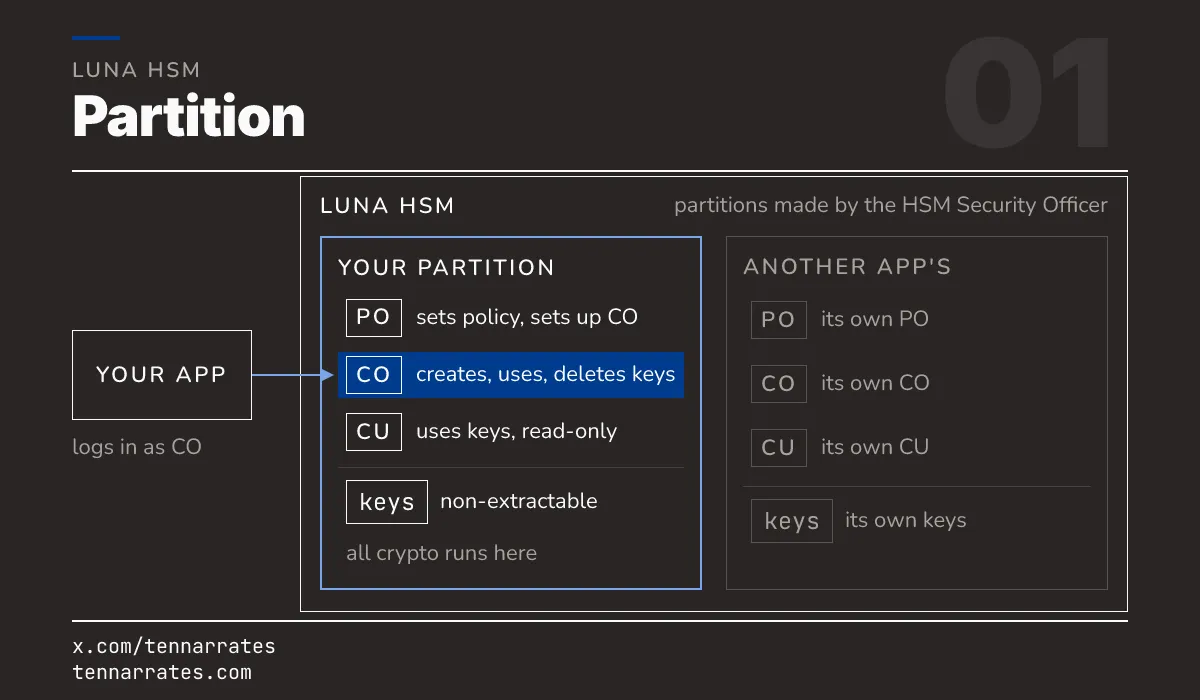
An application never communicates with the physical HSM appliance as a single undivided unit. An application partition is an independent virtual slice of an HSM. The HSM Security Officer creates these partitions on the appliance and assigns each partition to a registered client over the network. Each partition functions as an isolated virtual HSM with its own administrators and security policies. The Partition Security Officer is a role that manages partition policies. The Partition Security Officer initializes the partition, configures its policies, and initializes the Crypto Officer. The Crypto Officer is a role that creates and uses keys. Your Spring Boot application logs in under the Crypto Officer role to generate, sign, and delete cryptographic keys. The Crypto User is a role that uses keys read-only. Applications that only sign data without creating or modifying keys can use this restricted account. Other partitions on the appliance remain completely isolated.
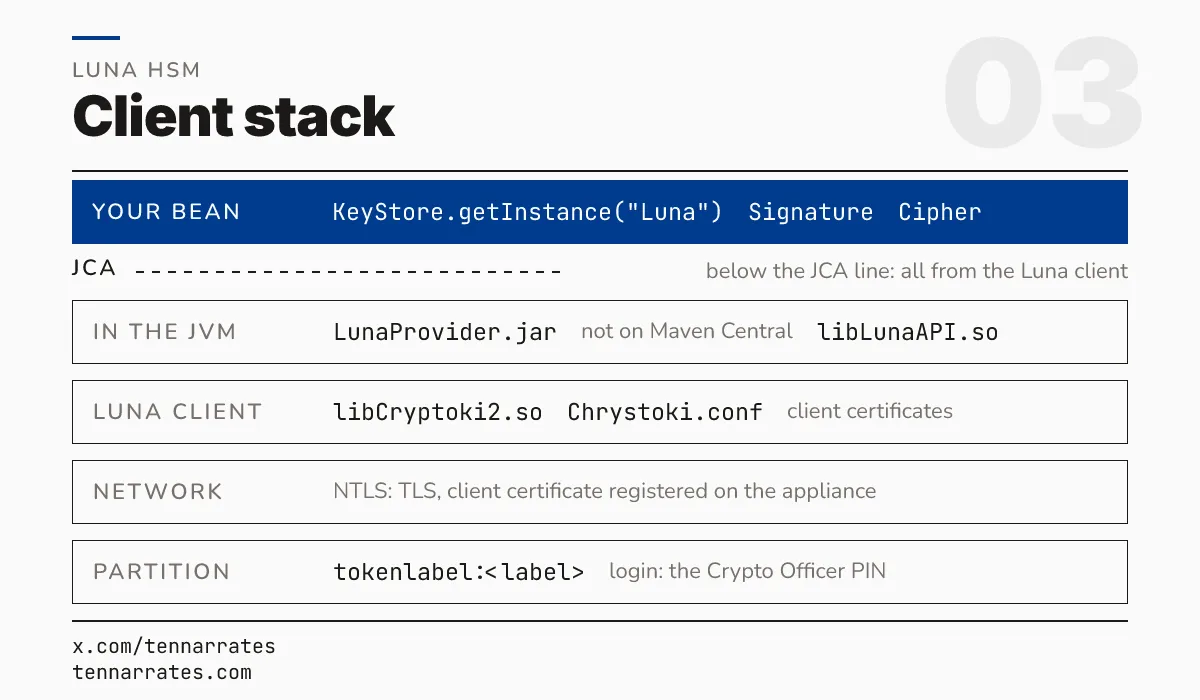
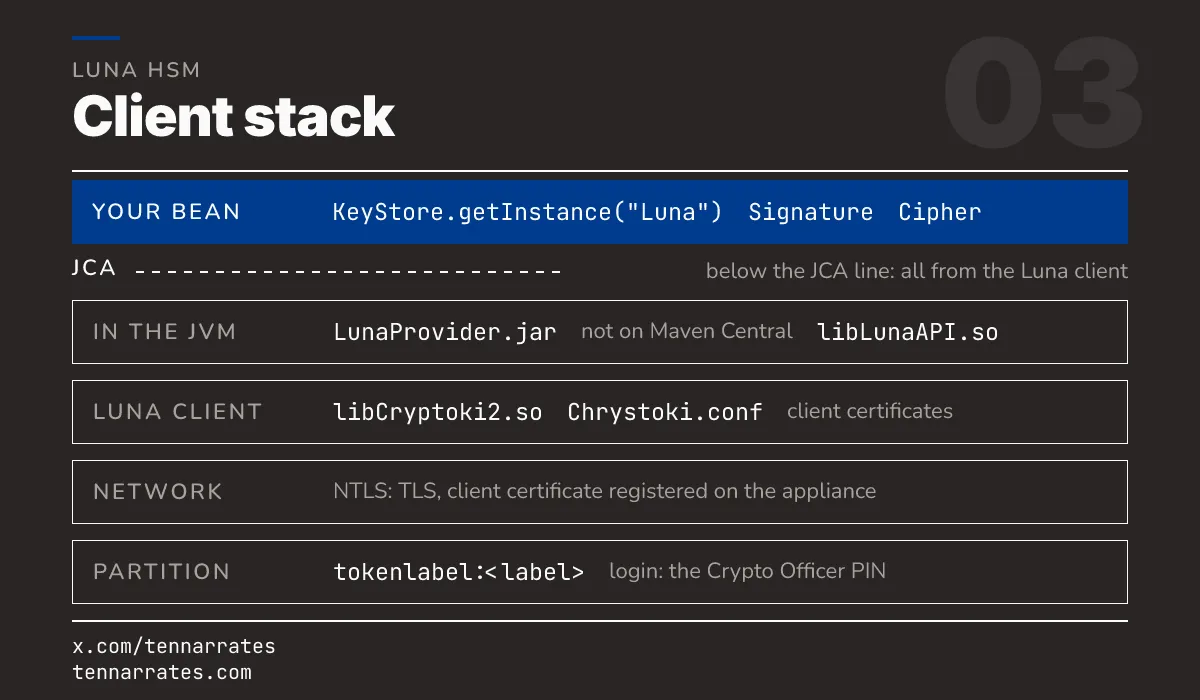
Between a Spring Boot bean and the remote HSM partition sits a stack of specialized software components. The Java Cryptography Extension provides implementations for encryption and signing. At the top layer, your Spring Boot service calls standard classes such as KeyStore, Signature, and Cipher. Below the Java layer, the runtime requires LunaProvider.jar on the classpath and libLunaAPI.so on java.library.path. Cryptoki is a standard procedural interface for cryptographic devices. Below the Java virtual machine, the Luna HSM Client provides libCryptoki2.so, configured by Chrystoki.conf, along with client certificates. Network Trust Link Service is a TLS link for HSM commands. Over the network, the client talks to the appliance through an NTLS channel that validates client and server certificates. At the destination sits the partition, addressed through tokenlabel:<label>, where the Crypto Officer PIN serves as the login credential.
If you launch a Spring Boot application without LunaProvider.jar on the classpath, the context fails during startup:
  Caused by: org.springframework.beans.factory.BeanCreationException: Error creating bean with name 'hsmProvider' defined in class path resource [com/tennarrates/lunahsm/HsmConfig.class]: Failed to instantiate [java.security.Provider]: Factory method 'hsmProvider' threw exception with message: com.safenetinc.luna.provider.LunaProvider
  Caused by: org.springframework.beans.BeanInstantiationException: Failed to instantiate [java.security.Provider]: Factory method 'hsmProvider' threw exception with message: com.safenetinc.luna.provider.LunaProvider
  Caused by: java.lang.ClassNotFoundException: com.safenetinc.luna.provider.LunaProvider
The Luna KeyStore Abstraction
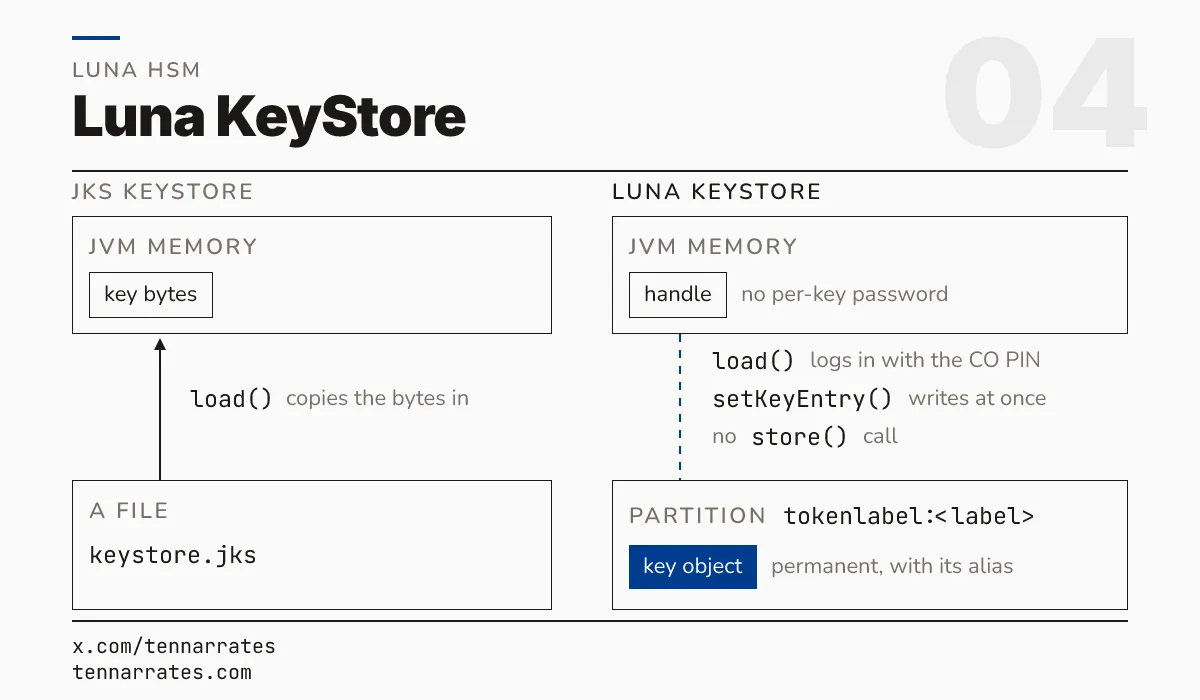
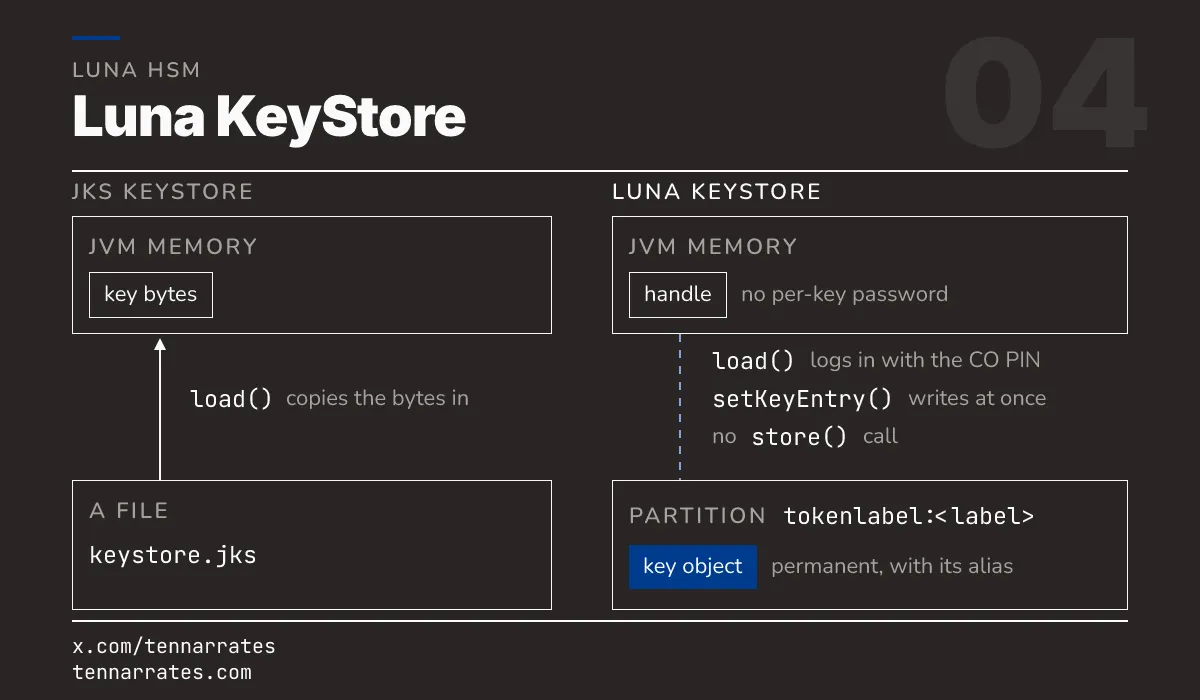
Java developers expect a keystore to behave like a standard file on disk. A KeyStore is a Java storage facility for cryptographic credentials. In standard Java development, loading a keystore reads serialized bytes from a local file and reconstructs private keys in heap memory. A Luna KeyStore operates differently because it acts as a virtual interface to the remote partition. When your code calls KeyStore.getInstance("Luna") and executes load() with tokenlabel:<label> and the PIN, the call logs the application into the partition. The objects returned by the keystore are handles to key objects that live permanently inside the HSM. When your code calls setKeyEntry(), the provider writes the key into the HSM immediately as a permanent token object. It persists without a save command. The provider does not wait for a subsequent store() call before persisting the object. In addition, individual keys in a Luna KeyStore cannot have unique passwords because partition authentication controls the entire session.
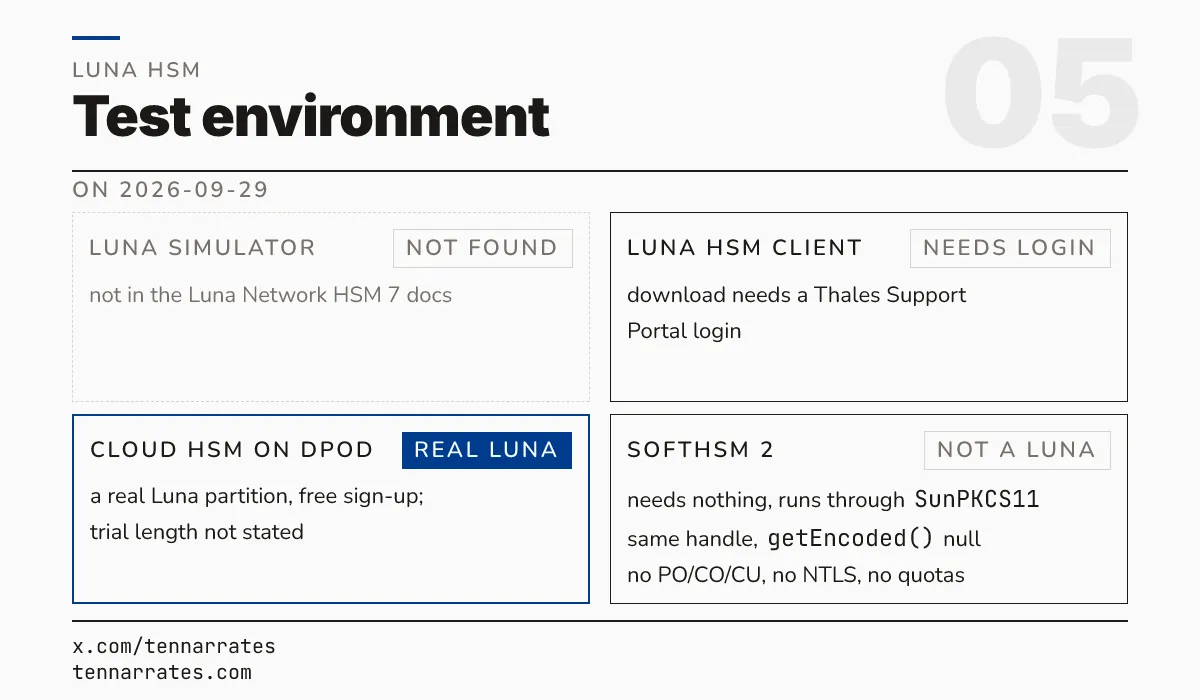
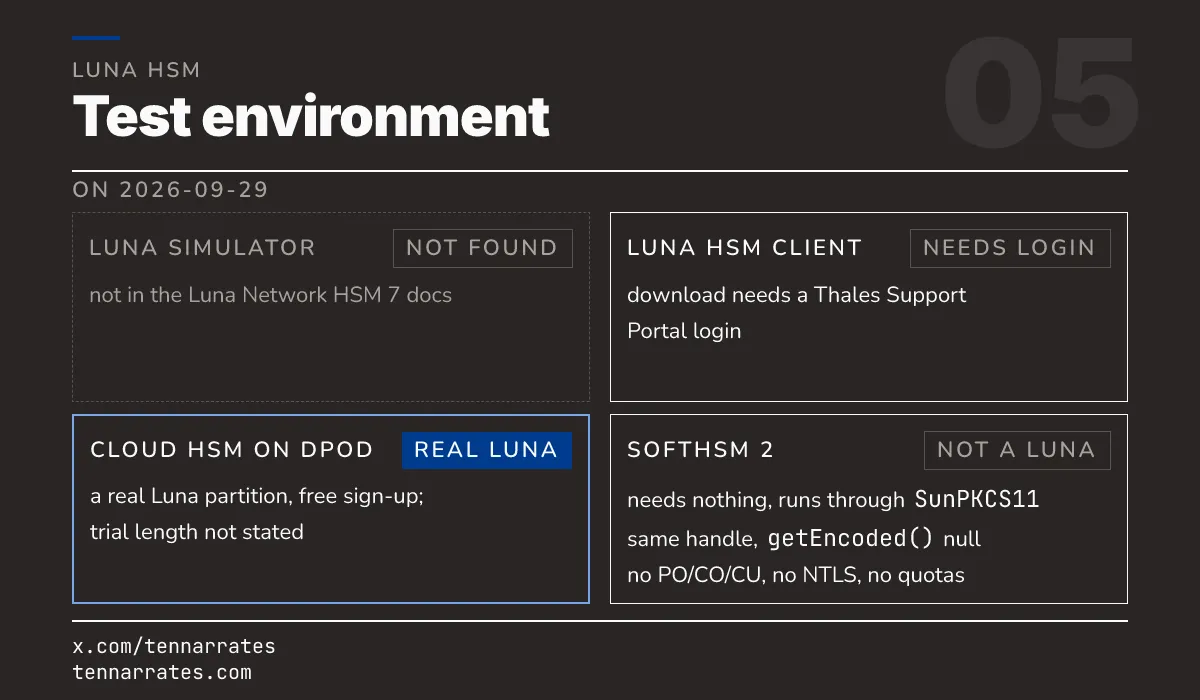
Physical HSM appliances are expensive and rare in local development environments. Developers often look for a local emulator or software simulator to test integration before deployment. No official simulator exists. A search across the complete documentation set of Luna Network HSM 7 confirms that no simulator exists:
  $ grep -ciE "simulat|emulat" toc_paths.txt
  0
      2614
Official client downloads also remain inaccessible without an existing enterprise contract. An unauthenticated guest request to download the client from the Thales Support Portal fails immediately:
  "recordIsValid": false
  "user_name": "guest", "logged_in": false
  Log in to view this secured article.
A developer without physical hardware has four distinct options to consider. Software simulators do not exist in the official product catalog. Official client packages require an active Thales Support Portal account. Luna Cloud HSM on Thales Data Protection on Demand provides a real remote Luna partition through an evaluation account. SoftHSM 2 provides an open source software token that works through the JDK built-in SunPKCS11 provider without accounts or external hardware.
Provisioning a Real Luna Partition on Cloud HSM
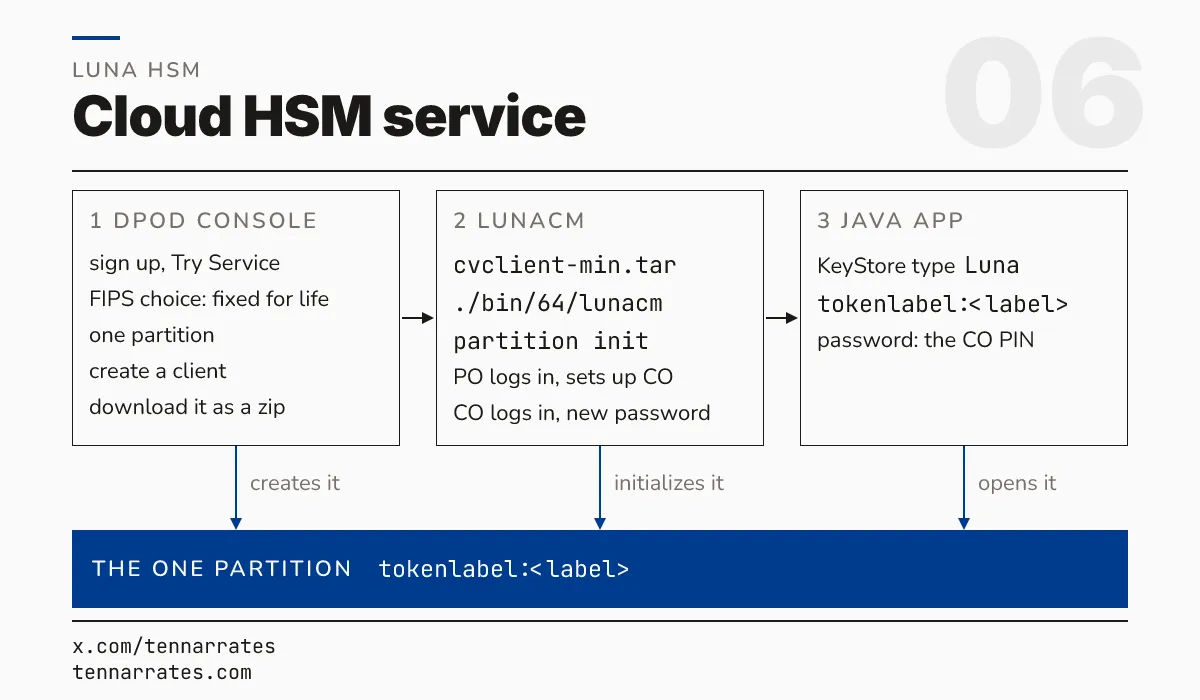
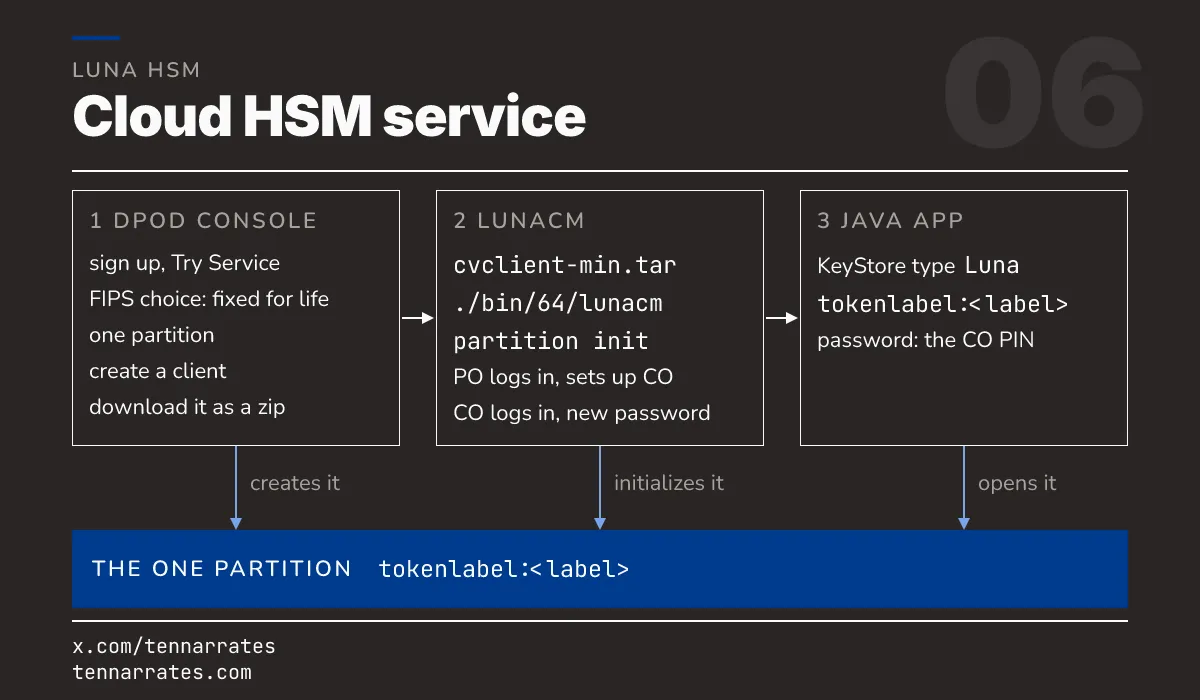
If you need to test against real Luna firmware without purchasing hardware, Thales Data Protection on Demand provides a cloud partition. You sign up for an evaluation tenant on the marketplace portal and select the Try Service option. During service creation, you must choose whether to remove FIPS restrictions. You cannot change this FIPS setting after service creation, so you must select the mode required by your compliance profile. The evaluation service provisions a single isolated partition for the tenant. You generate a client package in the portal, which downloads as an archive containing cvclient-min.tar. You unpack the client on an NTP-synchronized Linux machine and execute ./bin/64/lunacm. Inside lunacm, you initialize the partition label, log in as the Partition Security Officer, and initialize the Crypto Officer. You then log in as the Crypto Officer and establish a permanent password, which Thales requires at initial login. That password becomes the application PIN. Your Java application can then open a Luna keystore against tokenlabel:<label> using that Crypto Officer PIN.
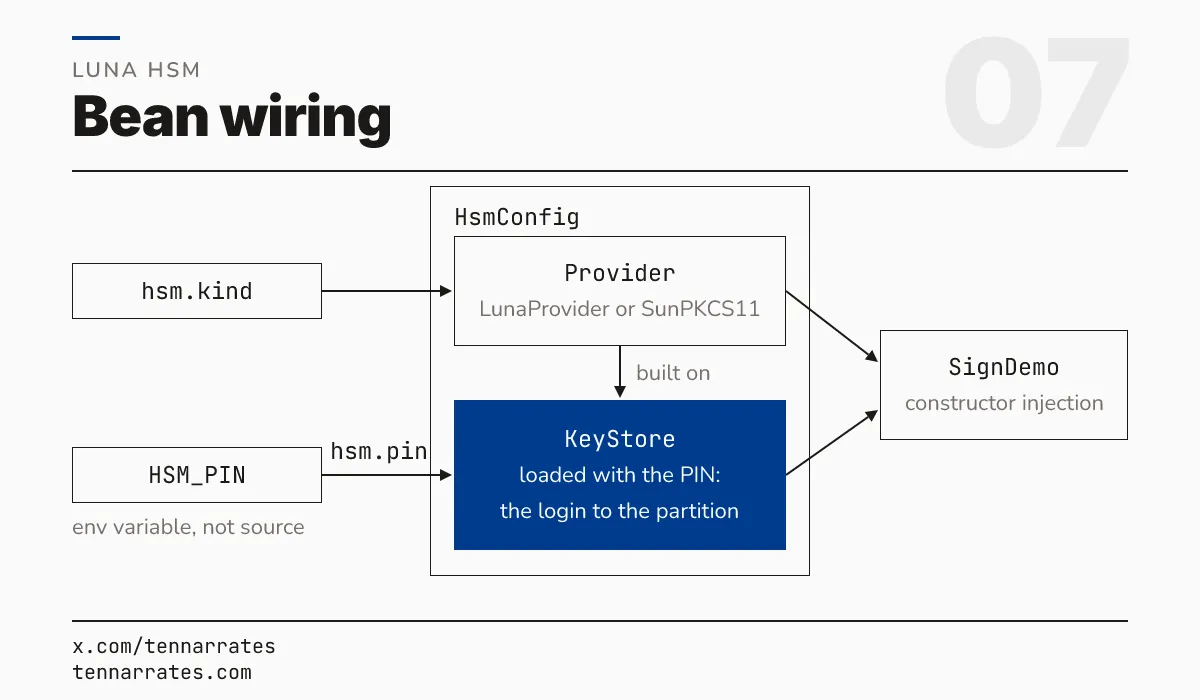
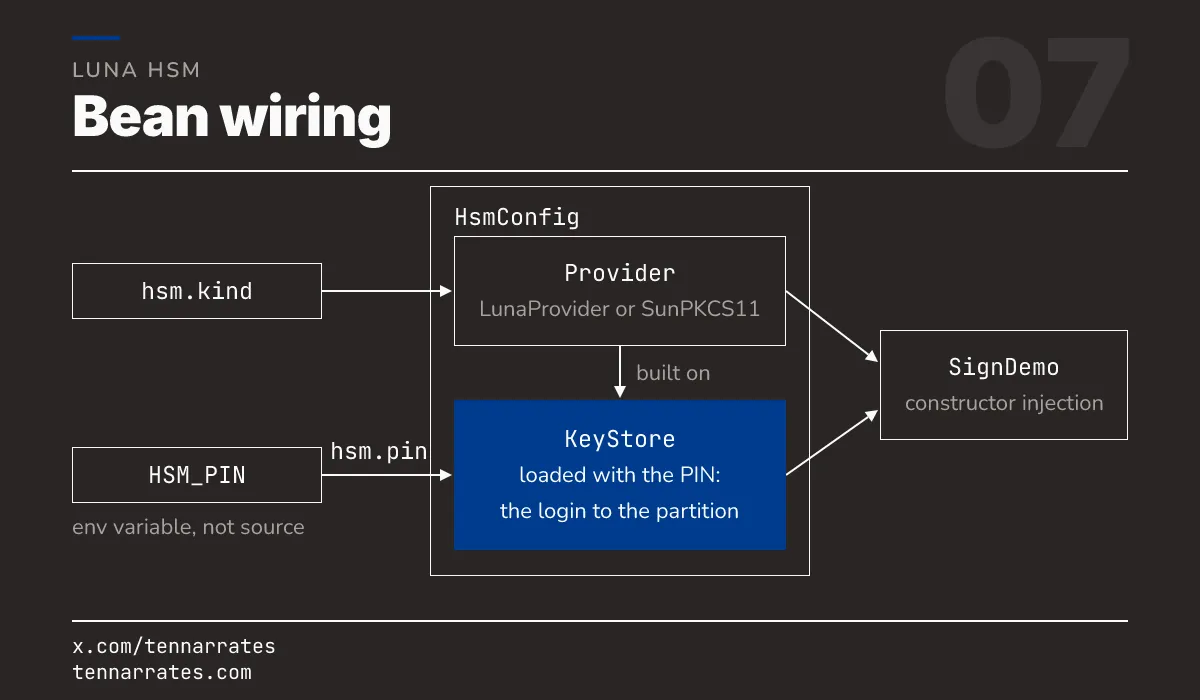
Integrating the HSM into a Spring Boot application requires registering two core beans inside a configuration class. The first bean is the java.security.Provider instance, instantiated dynamically as LunaProvider or configured via SunPKCS11. The application registers this provider dynamically with the Java security subsystem at startup. The second bean is the KeyStore instance initialized from that provider. Loading the keystore with the partition label and secret PIN performs the actual network authentication to the HSM. You must supply the Crypto Officer PIN through an external environment variable such as HSM_PIN, never through committed source code. Application components such as signing services receive both beans through constructor injection.
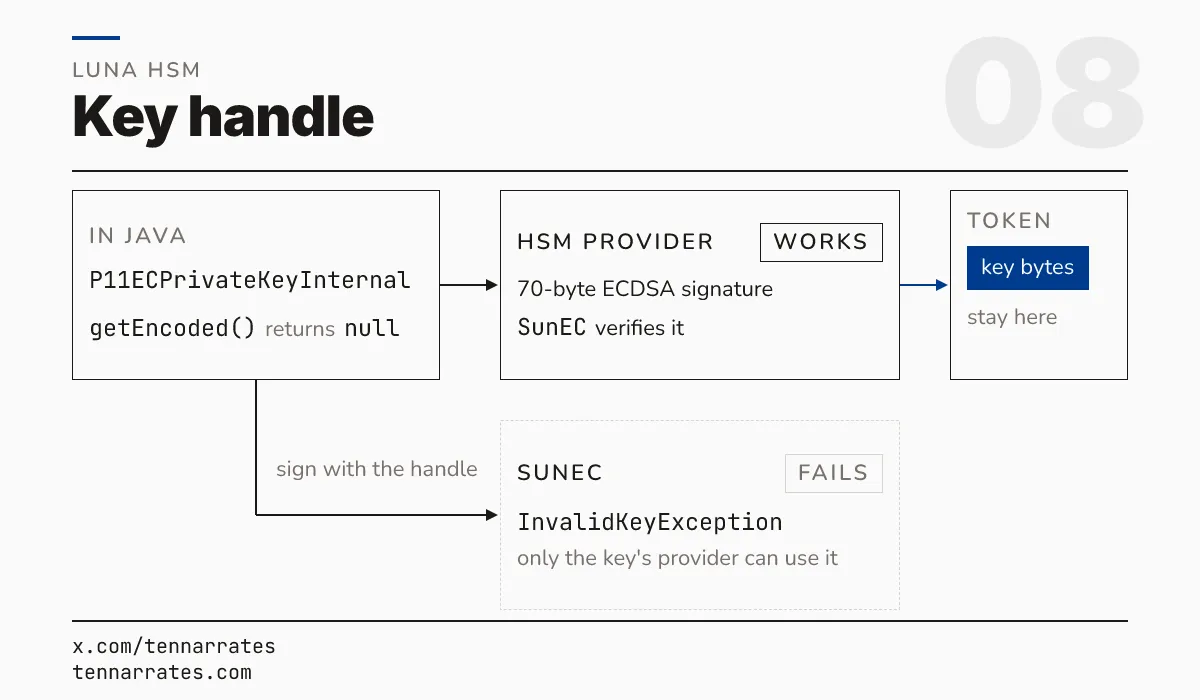
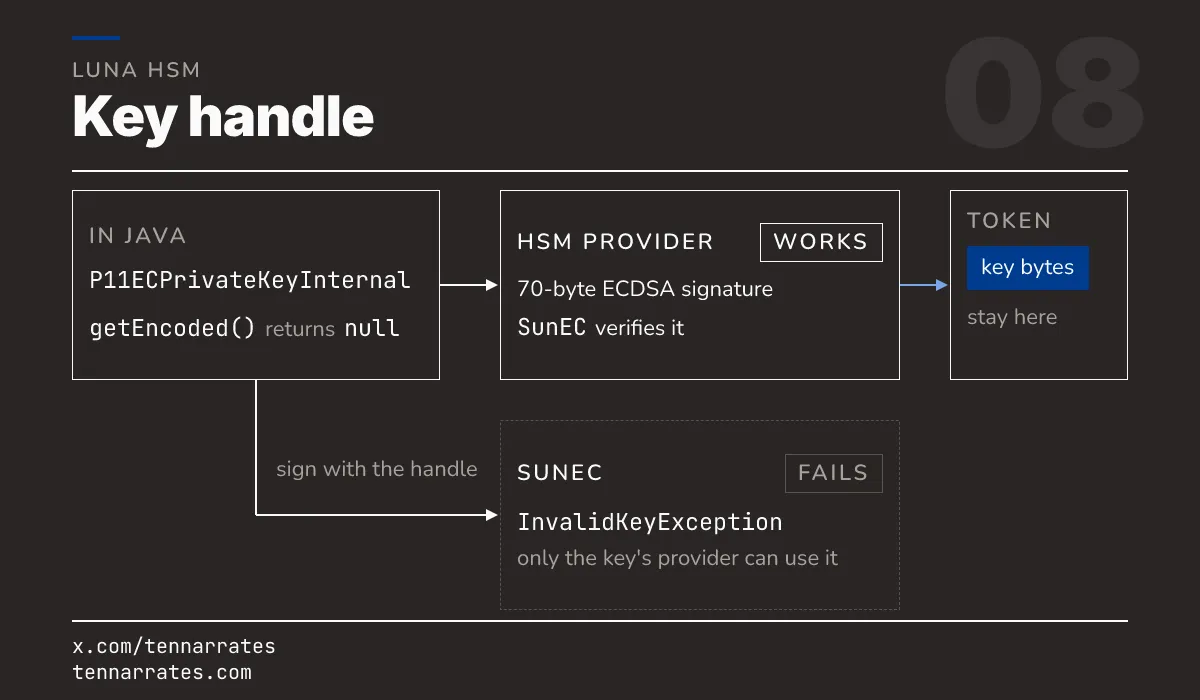
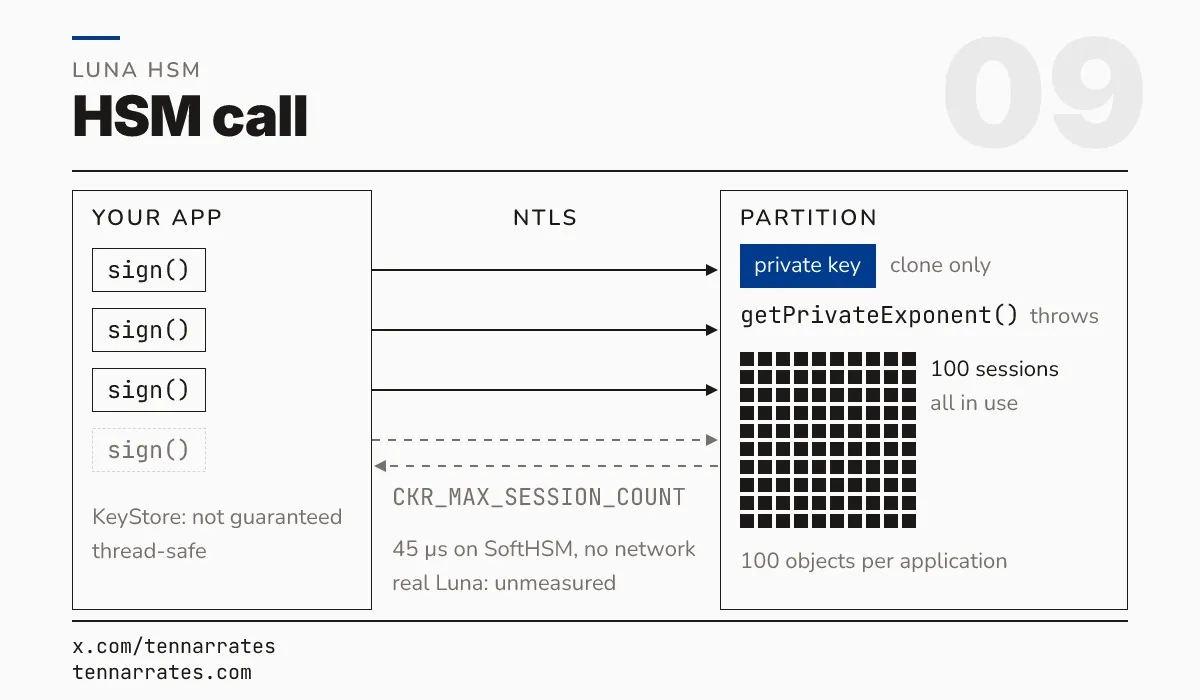
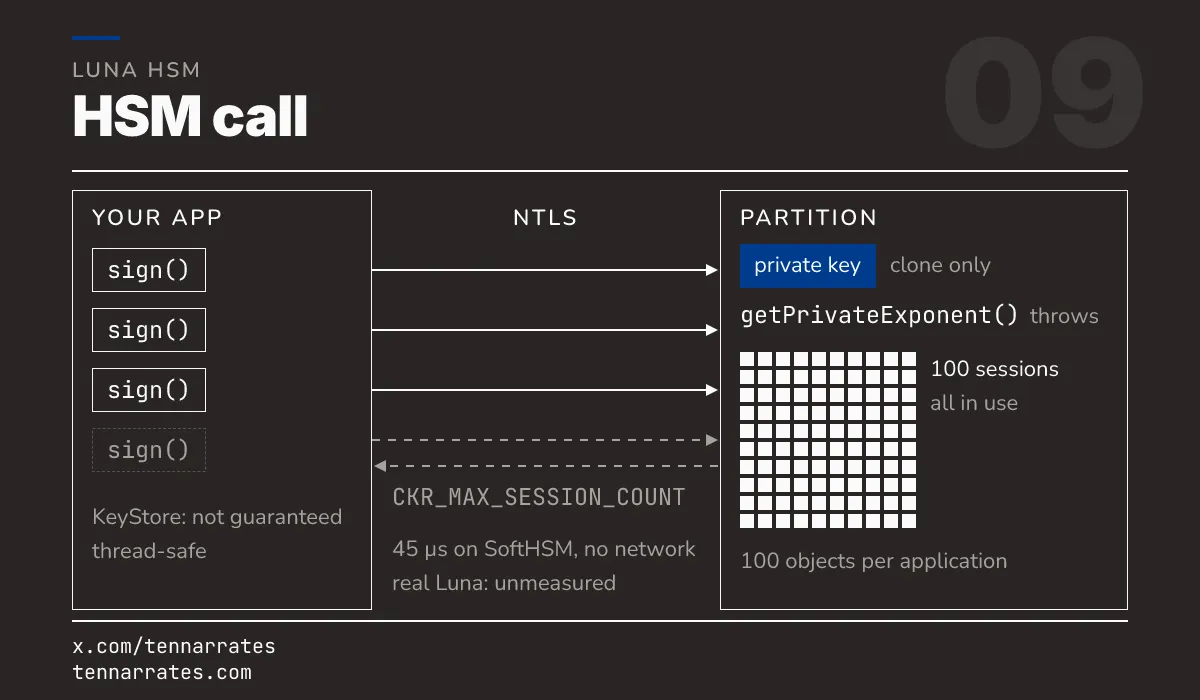
When you generate an asymmetric key pair using KeyPairGenerator backed by the HSM provider, the resulting private key is not an array of bytes. The returned private key is an opaque handle pointing to the object stored within the partition. In our test run, the key object is an instance of P11ECPrivateKeyInternal. Calling getEncoded() on this private key returns null because the raw private key bytes never leave the physical token. Elliptic Curve Digital Signature Algorithm is an asymmetric signing method. Signing data with this private key through the HSM provider succeeds and produces a valid signature that software providers can verify:
  private:   sun.security.pkcs11.P11Key$P11ECPrivateKeyInternal
  encoded:   null (key bytes stay in the HSM)
  signature: 70 bytes, verified=true (verified by SunEC)
If you pass this private key handle to the default JDK software provider SunEC, the operation throws an InvalidKeyException:
SunEC: InvalidKeyException: Private keys must be instance of ECPrivateKey or have PKCS#8 encodingThe software provider cannot inspect the private key structure because the internal key bytes do not exist in memory. The software signer fails immediately. Only the specific provider that manages the hardware partition can execute operations with that private key handle.
Because the private key remains inside the partition, every private key operation requires a round-trip network call. Local in-memory signing on SoftHSM completes in 45 microseconds without network latency:
timing: 500 signs, 45 us per signOver a real enterprise network using NTLS, each cryptographic request must traverse network switches, TLS handshakes, and appliance queues. Network hops add measurable latency. This network boundary changes throughput expectations and latency profiles for every signing endpoint. Hardware partitions also enforce strict operational quotas on active clients. Luna Cloud HSM limits an application client to 100 simultaneous sessions and 100 objects or 156 kilobytes of storage. If an application exceeds 100 concurrent sessions, the client returns error code CKR_MAX_SESSION_COUNT. In addition, the Luna KeyStore implementation is not guaranteed to be thread-safe across concurrent application threads. You must synchronize access externally or manage pooled sessions to avoid corrupting concurrent state.
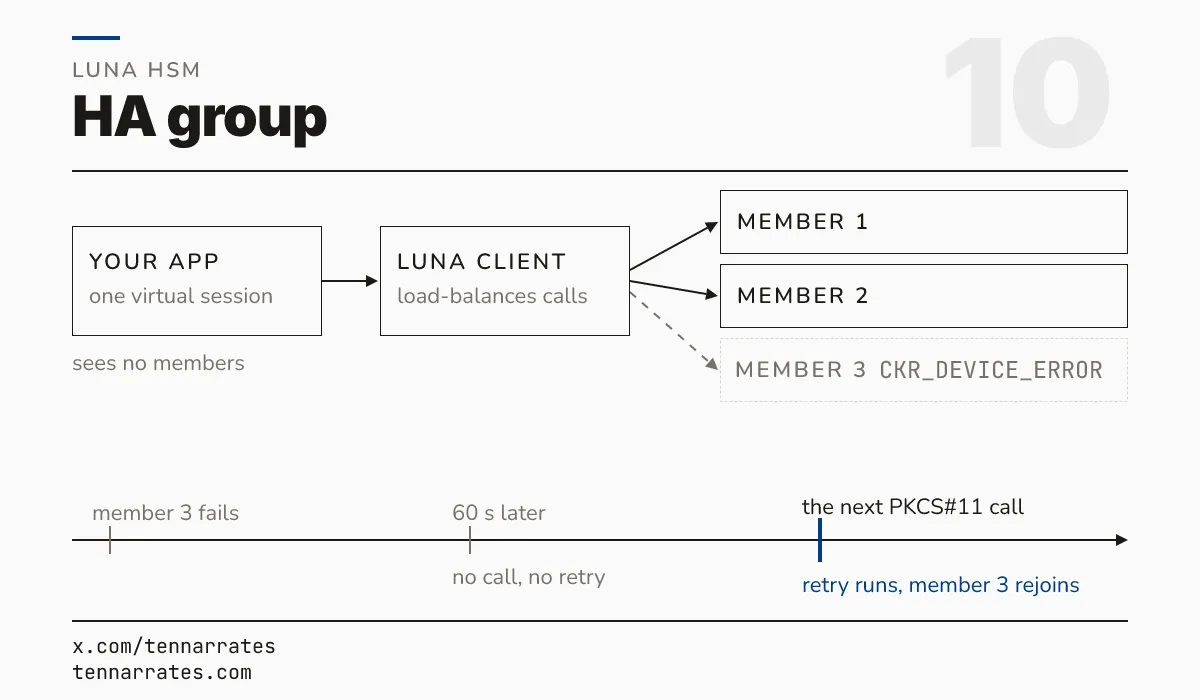
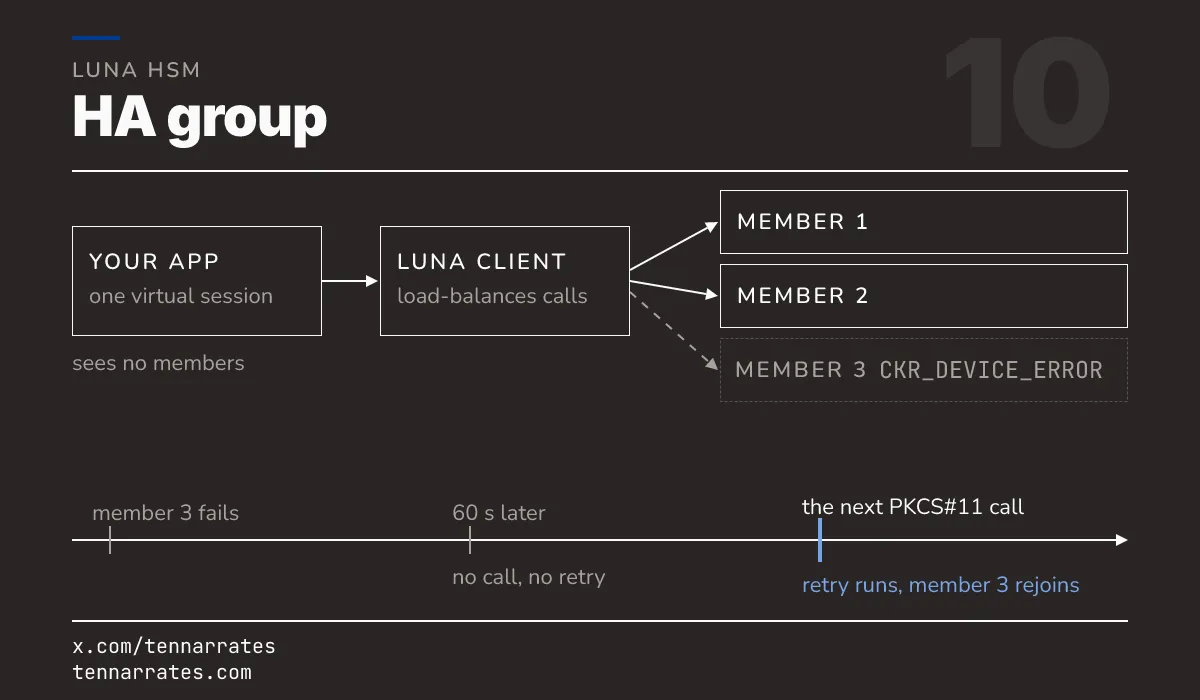
Production architectures rarely depend on a single physical HSM appliance. High Availability is a system design that prevents single-point failure. Thales provides High Availability groups that combine multiple HSM partitions into a single logical cluster. The Luna client presents a virtual session handle to the Java application and load-balances cryptographic operations across group members. If a member appliance disconnects or encounters a failure, the client marks the node with CKR_DEVICE_ERROR and routes requests to surviving members. The client attempts recovery of failed appliances every 60 seconds by default. However, this recovery mechanism executes only during an active PKCS#11 call from the application. If your application remains idle and initiates no cryptographic operations, the client will not attempt to reconnect to the recovered appliance. Reconnection requires an active request.
Moving a Spring Boot service from local development to an enterprise Luna HSM requires planning across software and infrastructure. If you prepare for production deployment, complete these verification steps:
- Verify that the application partition is initialized and the Crypto Officer changed the default password.
- Bundle
LunaProvider.jaron the application classpath and installlibLunaAPI.sowith the Cryptoki libraries on the host system. - Register the provider dynamically at application startup, placing it in third position as Thales documentation recommends.
- Pass the Crypto Officer PIN through environment variables or a secret manager, never through configuration files.
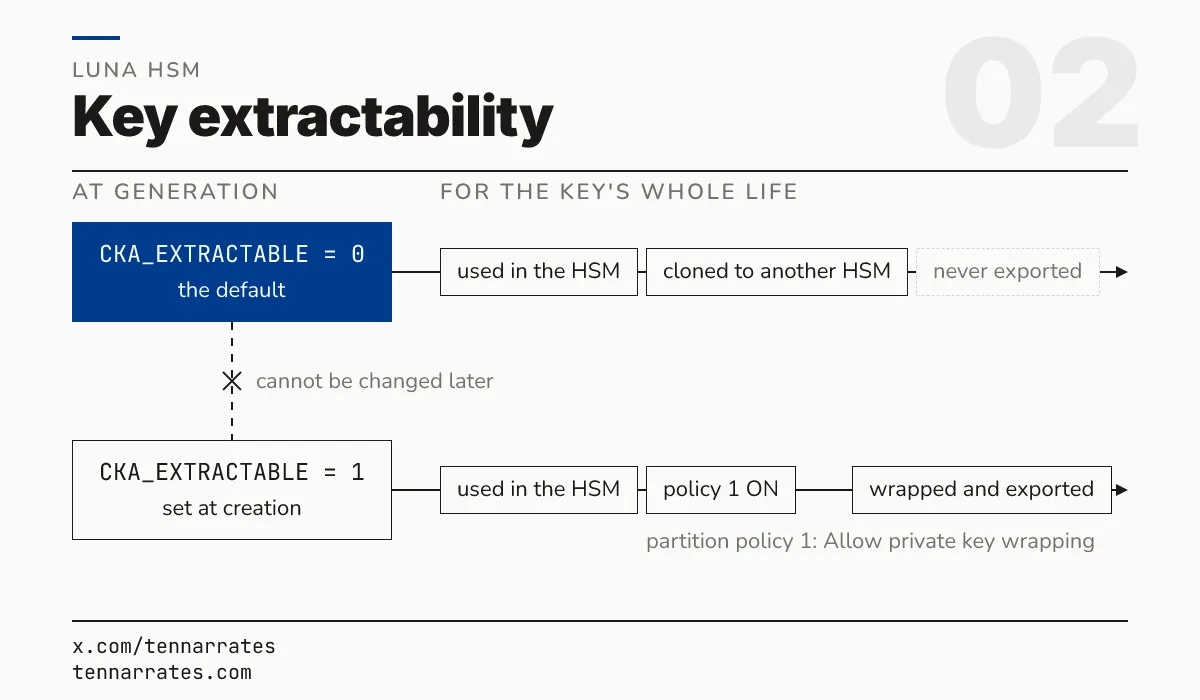
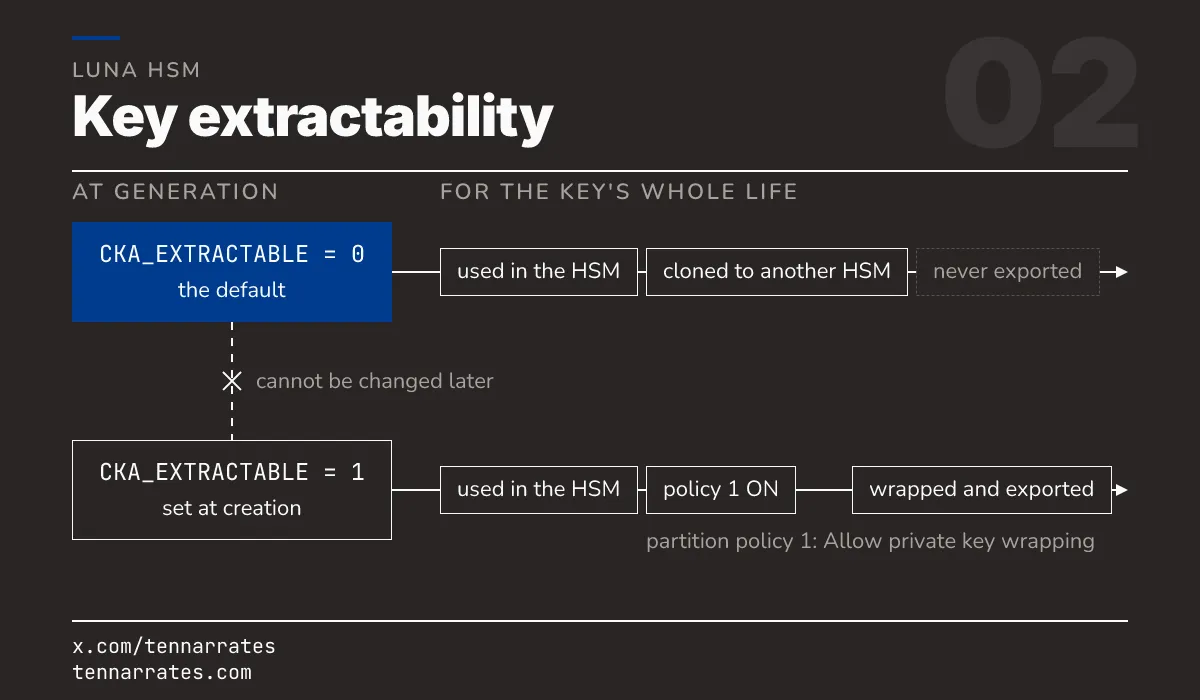
- Decide whether keys require export before calling key generation, because
CKA_EXTRACTABLEcannot be modified after creation. - Verify that your application thread pool respects session quotas and synchronizes concurrent calls through the keystore.
- Ensure that the client host synchronizes its system clock through NTP to prevent TLS and token authentication failures.